

Can a remap fix flat spots and poor throttle response?
Often, yes. Many of the causes live in the ECU’s mapping. Manufacturers restrict throttle opening and impose torque limiters to soften delivery, many bikes have power held back in certain gears and at certain rpm, and aftermarket parts can leave the fuelling out of step. A remap rewrites those settings for your bike.
In short
- Eliminating flat spots and improving throttle response are two of the things a BHP UK bike remap sets out to do.
- The usual culprits in the mapping are restricted throttle opening, torque limiters and power restrictions in certain gears and rpm.
- Fitting an exhaust or intake without a remap leaves the fuelling written for parts that are no longer there.
- We find these settings by logging the bike on our Dynojet 250i in every riding mode, then write the map in-house.
- A remap changes software. It can’t fix a part that has failed.
What causes flat spots and a hesitant throttle?
Your bike’s ECU carries torque and power limiters that cut output in certain situations, and many bikes have their power restricted in certain gears and at certain engine speeds. Our guide to what motorcycle remapping is explains what else the ECU controls.
When we log a standard bike on the dyno, we often find the manufacturer has restricted throttle opening or imposed torque limiters in the mapping to soften power delivery. From the saddle, that can feel like a throttle that doesn’t respond as quickly as you turn it, or power that arrives later or softer than the engine can give.
Fuelling plays a part too. Fuel-injected bikes have closed loop areas, where the ECU reads the oxygen sensor and corrects the mixture, and open loop areas where it can’t. Dynojet notes that standard narrowband sensors are only accurate at or near 14.7:1, the stoichiometric ratio for petrol. Everywhere outside closed loop, the ECU follows its stored map without checking the result, so a map that doesn’t suit the bike stays wrong.
Common complaints and what a remap changes
| What you notice | Where it can come from in the mapping | What we adjust |
|---|---|---|
| A flat spot at one part of the rev range or throttle opening | Fuelling or timing at that point in the map | Fuelling and spark advance across throttle positions and rpm |
| A dull or delayed response when you open the throttle | Restricted throttle opening and the throttle response curves | Throttle response curves and throttle plate opening |
| Power that feels held back in some gears or at some rpm | Torque and power limiters set by the manufacturer | Torque limiters |
| Uneven or lean running after an exhaust or intake change | A factory map written for the standard parts | Fuelling at every throttle position, lambda requests and closed loop monitoring |
Remapping the factory ECU means we can adjust any of these as needed.
What the results look like
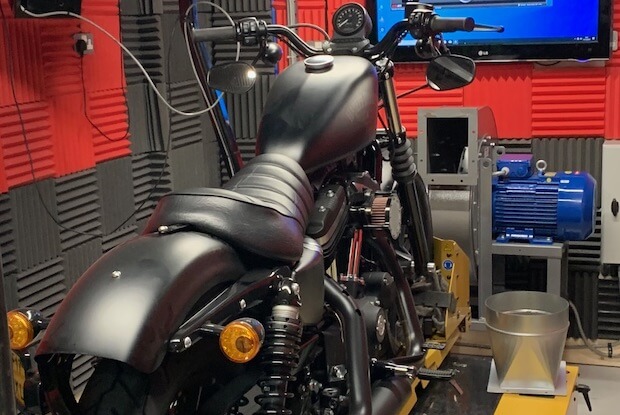
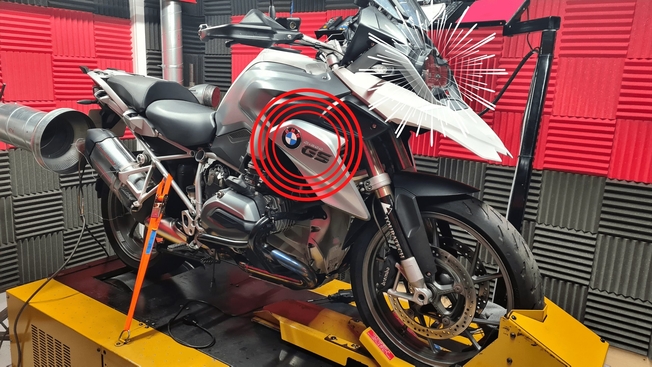
On the BMW R1200GS, most of the change was in how the bike rides rather than the peak figure: our map smoothed power delivery at throttle openings up to 80%. On our own Harley-Davidson Iron 883, rewriting the fuelling at every throttle position gave a throttle that responds instantly, with torque that stayed flat higher up the rev range. The figures for both are in how we develop bike remaps.
How we find the problem
Guessing at a flat spot doesn’t fix it. When we develop a map we log the bike on our Dynojet 250i with our own lambda sensors in every engine mode it has, which shows how the factory set it up and where improvements are possible, then road test the result. How we develop bike remaps lists everything we log.
What a remap won’t fix
A remap changes the ECU’s software. It’s the answer when the cause is in the mapping, not when a part has failed. If something on the bike is damaged or worn, that needs repairing first, and the map should be written for the bike in good working order.
Modified bikes
If the problem started after you fitted a new exhaust or air intake, the factory map is the likely mismatch: our advice is to remap whenever those parts change. Our guide to remapping after an exhaust explains why, including what we measured on the Iron 883. If you’re weighing up a remap against a fuel module, see remap vs Power Commander.
Related guides
- What is motorcycle remapping?
- Do you need a remap after fitting an exhaust?
- Remap your bike at home with the ECU Flasher
- Motorcycle remaps
Get your bike sorted
Find your make in our motorcycle remap finder, then call 01282 779 000 to describe what the bike is doing and book it in at our Burnley workshop. On many bikes you can also remap at home with our ECU Flasher, available from the BHP UK shop.
Frequently asked questions
What is a flat spot?
A point in the rev range or throttle opening where the bike stops pulling as cleanly as it does either side of it. When the cause is in the mapping, rewriting the fuelling and timing at that point is how a remap deals with it.
Why would a new bike have flat spots or a dull throttle?
Manufacturers often restrict throttle opening or impose torque limiters in the mapping to soften power delivery, and many bikes have power restricted in certain gears and at certain rpm.
Does a remap change every riding mode?
We run and monitor the bike in every engine mode it has when we develop a map. On the BMW R1200GS that meant Road, Enduro, Rain and Dynamic.
My bike only started hesitating after I fitted a new exhaust. Will a remap help?
Our advice is to remap whenever an aftermarket exhaust or intake is fitted, because the factory map was written for the standard parts. We write the map for your exact set-up.
Last updated 19 October 2026

Our Products & Services
All of our software, programming and tuning services are designed and built in-house and are designed to enhance your vehicle and bring out it’s pure & true performance potential.




© 2011 - 2026 BHP UK. All rights reserved.