

What is motorcycle remapping?
Motorcycle remapping means changing the settings stored in your bike’s engine control unit (ECU), the computer that controls fuelling, spark advance, throttle plate opening and closed-loop lambda monitoring. A remap recalibrates those settings, including any torque and power limiters, so the engine runs properly for your bike and its modifications.
In short
- Your bike’s ECU controls almost every part of how the engine runs, including limiters that hold power back in some situations.
- Manufacturers often restrict throttle opening or add torque limiters to soften power delivery.
- A remap can increase power, eliminate flat spots, improve throttle response and make the most of your modifications.
- After an aftermarket exhaust or air intake, a remap is essential to make sure the engine runs correctly.
- A remap changes the ECU’s own settings. A piggyback module adjusts signals from outside the ECU.
What does a motorcycle ECU control?
A modern motorbike ECU is a sophisticated computer. It controls fuelling, spark advance, throttle plate opening and closed-loop lambda monitoring. It also has torque and power limiters that limit the power produced in certain situations. Many bikes have their power restricted in certain gears and at certain engine speeds.
Remapping is the science of altering those parameters so the engine runs optimally.
Throttle and torque limiting
When we develop a remap we log the standard bike in detail to see how the manufacturer has set it up. On many occasions we find that the manufacturer has restricted throttle opening or imposed torque limiters in the mapping to soften power delivery.
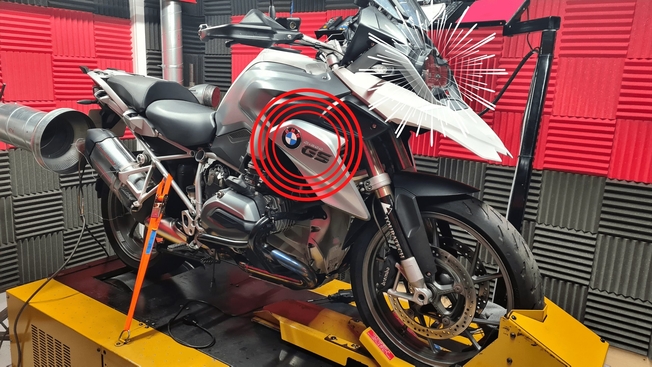
On our BMW R1200 GS, changing this smoothed power delivery at throttle openings up to 80%; the results are in how we develop our bike remaps.
Closed loop and open loop
Closed-loop lambda monitoring is one of the jobs the ECU does. A typical calibration has areas of “closed loop”, where the ECU can see the air-fuel ratio through its lambda sensor, and areas of “open loop”, where it can’t. Factory narrowband sensors are only accurate at or near the stoichiometric ratio, which is 14.7:1 for petrol. Outside the closed-loop areas the ECU relies on its stored map, and that map was written for the bike as it left the factory.
That is why a remap looks at fuelling across the whole range, not just at full throttle. On our Harley-Davidson remaps, the closed-loop monitoring and lambda requests are among the parameters we can adjust.
What a remap changes
A remap works on the factory ECU itself, so we can adjust any engine parameter we need to. On a Harley-Davidson, for example, that includes:
- fuelling
- spark advance
- throttle response curves
- torque limiters
- lambda requests
- closed-loop monitoring
A BHP UK remap will increase power, eliminate flat spots, improve throttle response and make the most of any modifications. It also saves the expense of buying a tuning module or “piggyback ECU”.
Why modifications make a remap important
Whenever a bike is modified with aftermarket upgrades such as an exhaust system or air intake, it is essential to remap the ECU to make sure the engine is running correctly.
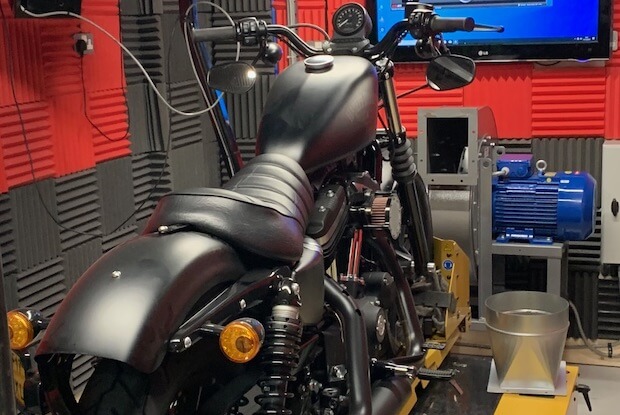
On our own Harley-Davidson Iron 883, a new exhaust left the engine running as lean as 18:1 in places; how we develop our bike remaps has the full story, and our guide to remapping after fitting an exhaust explains why it happens.
Remap vs a piggyback module
A piggyback module such as a Dynojet Power Commander fits in the wiring between the ECU and the fuel injectors and adjusts the fuel signal without rewriting the ECU. Dynojet describes its Power Commander V as optimising the air-fuel ratio “without directly changing the ECU”. A remap changes the settings inside the ECU itself. Our remap vs Power Commander guide compares the two.
How a remap gets onto your bike
We remap Harley-Davidsons through the on-board diagnostic port, working on the factory ECU. Other bikes can be done at our workshop, at home with an ECU Flasher, or by sending us the ECU: Remap your bike at home with the ECU Flasher explains each route.
How we develop our remaps
All of our remaps are developed by our in-house team of map writers. We don’t use base maps from other companies and simply tweak them to run on your bike. We run each bike on our Dynojet 250i, fit our own lambda sensors, log the engine in every riding mode and then road test the map. Read how we develop our bike remaps.
Which bikes can be remapped?
Our motorcycle tables cover 26 makes, from Aprilia, BMW Motorrad, Ducati, Harley-Davidson, Honda, Kawasaki, KTM, Triumph and Yamaha to scooter makes such as Piaggio and Vespa, and ATV and side-by-side makes such as Can-Am/BRP, CFMOTO and Polaris. Find yours in the motorcycle remap finder, or read our guides to scooter remapping and ATV and side-by-side remapping.
Talk to us
Call 01282 779 000 to talk about your bike, contact our Burnley workshop or find a local BHP UK dealer.
Related guides: Flat spots and throttle response · Remap after an exhaust · Remap vs Power Commander · All motorcycle remapping guides
Frequently asked questions
Is a remap only about more power?
No. As well as increasing power, a remap can eliminate flat spots, improve throttle response and make the most of modifications such as an aftermarket exhaust or air intake.
Do I need a remap after fitting an aftermarket exhaust?
Whenever a bike is modified with an aftermarket exhaust system or air intake, it is essential to remap the ECU so the engine runs correctly. Changes to the exhaust or intake can alter the air-fuel mixture.
Is a remap the same as a Power Commander?
No. A piggyback module such as a Dynojet Power Commander fits in the wiring between the ECU and the fuel injectors and adjusts the fuel signal without rewriting the ECU. A remap changes the settings inside the ECU itself.
Can I remap my bike at home?
If your bike is supported by an ECU Flasher on our online shop, yes. With the flasher you read your bike's ECU, send us the file and flash the map we return.
Last updated 19 October 2026

Our Products & Services
All of our software, programming and tuning services are designed and built in-house and are designed to enhance your vehicle and bring out it’s pure & true performance potential.




© 2011 - 2026 BHP UK. All rights reserved.