

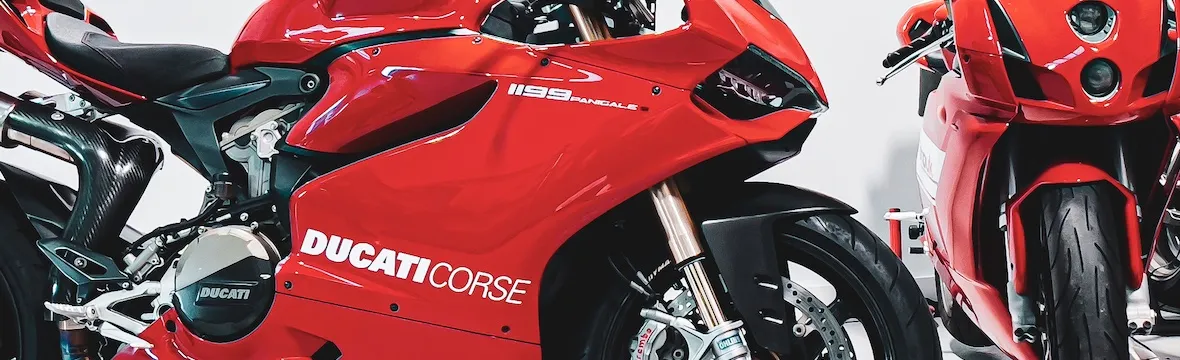
Do you need a remap after fitting an exhaust?
Our advice is yes. Whenever a bike is fitted with an aftermarket exhaust system or air intake, we remap the ECU so the engine runs correctly with the new parts. The factory map was calibrated for the standard exhaust and airbox. Change how the engine breathes and the fuelling it was written for no longer matches.
In short
- A new exhaust or intake changes the air going through the engine, but the factory map in the ECU doesn’t know that.
- Most fuel-injected bikes only correct their own fuelling in some areas of the map. Elsewhere they run on stored values with no feedback.
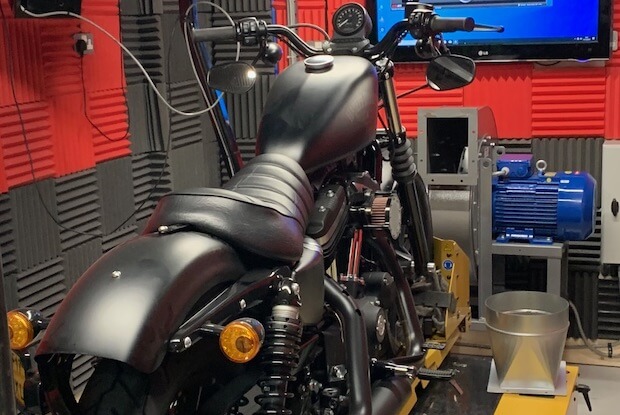
- On our own Harley-Davidson Iron 883, a new exhaust left the air-fuel ratio as lean as 18:1 in places.
- We log every riding mode when developing a map, and write it for your parts.
Why does a new exhaust change the fuelling?
Your bike’s ECU decides how much fuel to inject from maps stored in its software, and those maps were set up by the manufacturer for the parts the bike left the factory with. Our guide to what motorcycle remapping is explains what else the ECU controls.
Fuel injection systems have closed loop and open loop areas. Dynojet, writing about Harley-Davidson calibrations, puts it simply: “there are areas where it can ‘see’ the AFR and other areas where it can not.” In closed loop, the ECU reads the oxygen (lambda) sensor and trims the fuelling. The standard narrowband sensors are only accurate at or near 14.7:1, the stoichiometric ratio for petrol; Dynojet gives their reliable window as 14.3 to 15.2. The ECU itself decides where closed loop applies; everywhere else it follows its stored map without checking the result.
So when an exhaust or intake changes how the engine flows, the mixture can move in exactly the areas the ECU can’t see. Correcting that means changing the map itself.
What we found on our own Harley
When we fitted an aftermarket exhaust to our own Harley-Davidson Sportster Iron 883, the engine ran very lean: the air-fuel ratio measured on the dyno reached 18:1 at points. That is why we measure rather than guess. The results after the remap are in how we develop bike remaps, and the full write-up is on our Iron 883 Stage 1 page.
Slip-on, full system or intake: what changes?
| Change | What gets replaced | Our advice |
|---|---|---|
| Slip-on silencer | The silencer (end can) only; the standard header pipes stay | Remap, so the fuelling matches the new silencer |
| Full exhaust system | Header pipes and silencer | Remap |
| Air filter or intake | The filter element, or the airbox and intake parts | Remap |
| Exhaust and intake together | Both ends of the engine’s breathing | Remap for the combination, not each part on its own |
We don’t rank these by how far out the fuelling will be. That depends on the bike, the parts and how the manufacturer set up the original map, and the only reliable way to know is to measure it.
Signs the fuelling is off
A remap is meant to eliminate flat spots, improve throttle response and optimise any modifications, so if your bike feels flat or hesitant on its new parts, tell us. Lean running is harder to spot: you may not feel it at all, which is why a dyno with air-fuel ratio logging matters. Our guide to flat spots and throttle response covers the common complaints in more detail.
Remap or fuel module?
A fuel module is the other common route. Dynojet describes its Power Commander V as a device that “optimizes your air/fuel ratio without directly changing the ECU”. A remap changes the ECU’s own software instead, with nothing extra fitted to the bike. We compare the two in remap vs Power Commander.
How BHP UK maps a modified bike
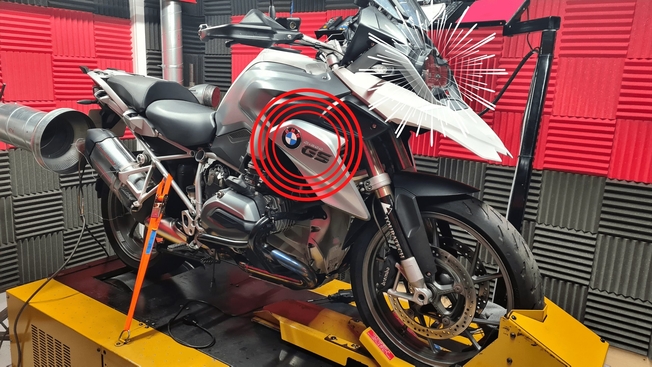
All of our remaps are developed by our in-house team of map writers. We don’t take another company’s base map and tweak it to run on your bike. We log each bike on our Dynojet 250i with our own lambda sensors, and because we develop on our own bikes we can test different modifications to see how they affect the engine; our guide to how we develop bike remaps covers it step by step.
You can have your modified bike remapped at our Burnley workshop, at home with our ECU Flasher, or by sending us the ECU; remap your bike at home explains each route. Whichever you choose, tell us every part that’s been changed.
Related guides
- What is motorcycle remapping?
- Remap vs Power Commander
- Flat spots and throttle response
- Remap your bike at home with the ECU Flasher
- Motorcycle remaps
Talk to us about your bike
Find your make in our motorcycle remap finder, then call 01282 779 000 to talk through your parts and book a remap at our Burnley workshop. Prefer to do it at home? Order an ECU Flasher from the BHP UK shop. You can also search our remap dealer directory.
Frequently asked questions
Do I need a remap for a slip-on silencer?
Our advice is to remap whenever the exhaust or intake is changed, slip-on included. How far the fuelling moves depends on the bike and the parts, so we measure it rather than guess.
Can you remap a bike that already has an aftermarket exhaust and air filter?
Yes. We write all our maps in-house, so we can tune them for your modifications. Tell us exactly which parts are fitted so the map matches your bike.
Can I get the remap done without bringing the bike to Burnley?
On many bikes, yes. Our ECU Flasher lets you read your ECU at home with a Windows PC, send us the file and load the remap we write for your bike and its modifications. Some models need the ECU sent to us instead.
Last updated 19 October 2026

Our Products & Services
All of our software, programming and tuning services are designed and built in-house and are designed to enhance your vehicle and bring out it’s pure & true performance potential.




© 2011 - 2026 BHP UK. All rights reserved.