

OBD vs bench vs boot-mode remapping
OBD, bench and boot mode are three ways of reaching the software in an engine control unit (ECU) to read and write it. OBD works through the vehicle’s diagnostic socket with the ECU left in place. Bench uses the ECU’s own harness connector with the unit removed. Boot mode means opening the ECU and connecting to its circuit board.
In short
- OBD: the ECU is read and written through the diagnostic socket. The ECU stays in the car and isn’t opened.
- Bench: the ECU is removed and connected through its harness connector. The case stays closed.
- Boot mode: the ECU is opened and the connection is made on its circuit board.
- Which method a vehicle needs depends on the vehicle and its ECU.
- At BHP UK, most modern cars are reprogrammed through the OBD port, with no need to dismantle the ECU.
What is the OBD port?
OBD stands for on-board diagnostics. The OBD port is the vehicle’s diagnostic socket. It is usually located under the steering wheel.
The same socket used to read fault codes can, on many vehicles, also be used to read and write the ECU’s software. That is what remappers mean by OBD remapping.
The three methods compared
| Method | Where the connection is made | What happens to the ECU |
|---|---|---|
| OBD | The vehicle’s OBD diagnostic socket | Stays in the vehicle, unopened |
| Bench | The ECU’s harness connection point | Removed from the vehicle, case not opened |
| Boot mode | The ECU’s printed circuit board (PCB) | Case opened to connect to the circuit board |
OBD
Reading and writing happen through the diagnostic socket. Nothing is unbolted or unplugged, and the ECU stays where the manufacturer fitted it.
Bench
With bench access, reading and writing happen over the controller’s harness connection point. The ECU is removed from the vehicle, but its case is not opened.
Boot mode
Boot mode requires the controller to be opened. The connection is made directly on the ECU’s printed circuit board.
How BHP UK remaps your car
Normally, on most modern cars, we can reprogram the ECU through the car’s OBD port. On vans the process is the same: the tuning is done with a laptop and tuning equipment connected to the vehicle’s OBD diagnostic port, and we don’t have to remove the ECU. The majority of turbo diesel vans made after 2000 can be remapped through the OBD port, including the Mercedes Sprinter and Vito, Ford Transit, Renault Trafic and Master, Vauxhall Vivaro and Iveco Daily. On vans we also run a diagnostic check before and after the remap.
Whichever way the ECU is reached, we always remap the file we read from your vehicle’s ECU. That makes the remap bespoke to your car. We never reuse a remap and never use generic “off the shelf” files.
Does the access method change the remap?
No. The access method decides how the software is read and written. The remap is the file itself, and that depends on the development work behind it: before we remap a customer’s car, we have already developed and tested the remap for that make and model on the road and on our rolling road. Read more about our dyno development.
Which method does my car need?
That depends on the vehicle and its ECU, so there is no single answer for every car. Call us on 01282 779 000 with your vehicle details and we will tell you how your car is remapped.
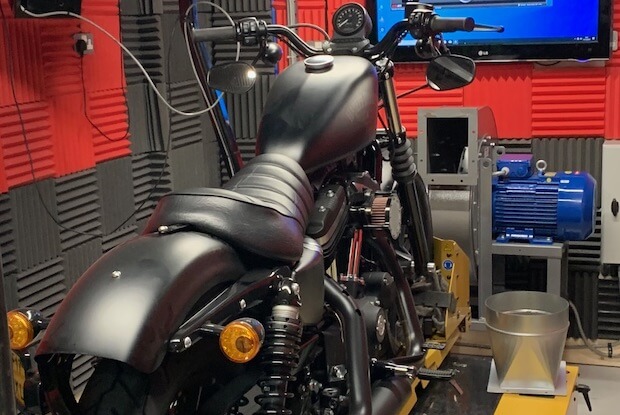
Motorcycles work the same way. We remap Harley-Davidsons through the on-board diagnostic port, for example, while some bikes on our online shop are marked “ECU OUT” because the ECU has to be sent to us. See What is motorcycle remapping? and Remap your bike at home with the ECU Flasher.
Talk to us
Look up your car in our remap finder, call 01282 779 000 for a free consultation, contact our Burnley workshop or find a local BHP UK dealer.
Related guides: What is ECU remapping? · Remap vs tuning box · Can a remap be reversed? · All car remapping guides
Frequently asked questions
Where is the OBD port?
The OBD port is the vehicle's diagnostic socket. It is usually located under the steering wheel.
Will BHP UK need to take my ECU out?
Normally, on most modern cars, we can reprogram the ECU through the car's OBD port, so the ECU stays in the car.
Can vans be remapped through the OBD port?
The majority of turbo diesel vans made after 2000 can be remapped through the OBD port. We connect a laptop and tuning equipment to the van's diagnostic port, so the ECU does not have to be removed.
Does the access method change the remap?
No. OBD, bench and boot mode are ways of reading and writing the ECU's software. The remap itself is the file our map writers develop for your engine.
Last updated 19 October 2026
Book ECU Remapping & Performance Chip Tuning Right now!
Speak To An Expert: Call 01282 779 000
Browse Our Remap & Engine Tuning Database
Browse our Vehicle Stat database and see the potential upgrades available for your vehicle
Our Dyno Tuning Stats for

Our Products & Services
All of our software, programming and tuning services are designed and built in-house and are designed to enhance your vehicle and bring out it’s pure & true performance potential.




© 2011 - 2026 BHP UK. All rights reserved.